Showing posts with label innovation. Show all posts

Tuesday, July 15, 2014

this is funny... a key holder that gives you a choice... ride the bike, or if you choose the car keys it will dump your bike key on the floor for you to pick up, as you obviously need the ab workout


If you usually drive, you’ll probably drive, even if you want a little extra exercise or a lower carbon footprint. But a new design tries to change that habit by inserting a tiny bit of annoyance in your everyday routine.

The Keymoment is a key rack that holds your bike key and car key at opposite ends. If you choose the car key, the bike key will automatically drop to the ground, forcing you to pick it up and hold both keys in your hands. Suddenly you’re considering the bike ride one more time.

Found on http://www.fastcoexist.com/3031764/these-clever-designs-annoy-you-until-you-break-your-bad-habits  

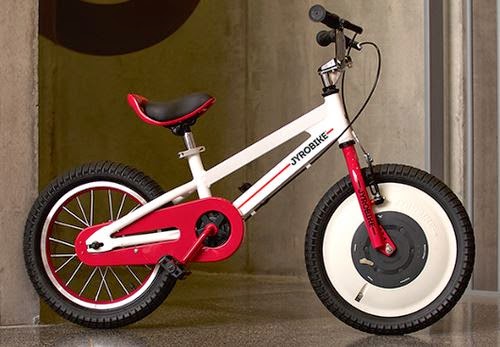
instead of training wheels... a gyro for added balance and stability in kids first bikes and old people's last bikes


The secret is a quickly-spinning disc inside the front wheel, which uses gyroscopic force to automatically balance the small bike whenever it starts to wobble. For kids, it’s a way to learn how to ride a bike in an hour or two.

 But unlike using training wheels, it starts teaching the art of balance from the beginning; if you lean too heavily, the bike will tip over.

We found a sweet spot to provide a lot of stability to give the child confidence, which is sort of half the battle with kids learning to ride.”

Sometime next year, the company plans to introduce an adult version as well, intended mostly for older riders who have balance issues or those with disabilities.

 "So you would have an adult who might be more or less wobbly, depending on the speed and their abilities and their height, and the Jyrobike would automatically compensate for that until they become stable." The company is working on research now with the government in the Netherlands, where 70% of trips happen by bike.

(interesting... of course, getting a 3 wheeler first gets kids used to steering without dealing with the balance issue. Baby steps idea to learning to ride 101)

Found on http://www.fastcoexist.com/3031873/fund-this/no-more-training-wheels-this-bike-for-kids-just-wont-fall-over?utm_campaign=home&utm_source=tumblr&utm_medium=exchange&partner=tumblr

Wednesday, June 11, 2014

most brilliant innovation in parking garages I've ever seen....


thanks to my commentors (you guys are great!) I learned these are used at Baltimore Washington airport, in Brussels, and Germany

3rd world problem vs 1st world problem


How to get water home, and how to transport a commuter with an rv bus


What a crazy world. I compliment the inventor of that water wheel... brilliant.

Both images from http://stunningpicture.tumblr.com/

Tuesday, June 10, 2014

Sneaky Pete Robinson anecdotes

In the recent issue of Hot Rod Deluxe, Drew Hardin retells a story from Dave Wallace, that Pete failed tech for being 200 pounds under weigh in, then came back about a hour or so later with everything looking the same... but at the right weight. He'd just went through the effort of pranking the inspectors with a hollow engine and blower. Nothing inside it.

When cars were weighed with the driver, Pete would be in the car with nothing on under the fire suit.

He started with the tires, talked about choice of tires and tubes, and contemplated filling them with helium rather than air. 

The only way he figured he could save some weight was to have his seat belts made to exactly the correct length so they didn't need an adjustment buckle!

While racing a SBC the new Ford Cobra 289 engine was released, he switched because it was 50 pounds lighter. He won top gas and beat Don Garlits.

At one match race at Lions, Pete was facing Garlits, and although Lions (Long Beach) wasn't a NHRA track, Don had stipulated that Pete could not use the jacks as a condition of the match race. The cars push started down the strip from the big end and made the 180-degree turn to approach the starting line. Pete stopped 10 feet behind the line, raised the car onto the jacks, let out the clutch. He calmly reached out of the driver's seat of his slingshot holding a wire brush in his hand, cleaning the dirt and pebbles off each slick. He then put the clutch in, stopped the tires from spinning and staged. Pete said Garlits looked over and saw what he was doing and got so psyched that Robinson managed to win the match race with a hole shot 30 seconds later. http://www.dragracingonline.com/features/peterobinson.html

After a lot of thought he came up with the "vacuum cleaner" concept. Attached between the frame rails was a piece of 15-inch wide by 4-foot long panel of honeycombed aluminum, parallel to the ground, directly under the engine. Then he fastened rubber "curtains" extending down from the panel, perpendicular to the track, around its circumference. They just brushed against the asphalt, making a closed chamber under the car. Then he built a piece of oval cross section aluminum tubing, one end of which fit snugly into the mouth of the Enderle injector atop his blower, extending forward. The tubing then curved down 90 degrees directly in front of the blower drive, with the other end scaled into a hole cut in the top of the chamber. Start the motor and you've got a chamber under the car sucking it down. The whole thing didn't weight 25 pounds.

Friday, May 30, 2014

Do you know why the Wright Bros. beat out all the competition in the race to taking the first flight? Action.

Robert Greene explains in Mastery that the Wright Bros. had a tight budget and were forced to make small, cheap tweaks to each model.

They would fly a plane, crash it, tweak it, and fly it again quickly. The corporations had budgets that allowed them to go back to the drawing board (i.e. abstraction) with each failure.

They spent a ton of money and time on each redesign. The Wright Bros. had a hundred test flights in the time it took these big corporations to complete a handful.

 Every test flight taught lessons – the one who failed fastest gathered the most information. 

from http://www.artofmanliness.com/2014/05/19/10-overlooked-truths-about-taking-action/

Thursday, May 29, 2014

brilliant cop I came across this morning... he's not chasing violators, he's just letting them come to him


The cop just waited in the middle on the jammed up on ramp, and every stupid person with a cell phone to their ear, or their seat belt off were pointed off to the side, and then gave tickets. Zero effort, maximum effect. Why in the hell aren't more cops this smart? If you want to stop cell phones users, and seat belt scoffers.... hell, even cracked windshields, bald tires, and whatever the rest of the simple visual moving violations there are to see 

Packard's Torsion Level suspension... motorized torsion bar leveling

Even more impressive was 1955 engineering. Leading the list of features was Torsion-Level suspension, an interlinked torsion-bar arrangement Nance acquired from a clever inventor, Bill Allison.

 Operating on all four wheels, Torsion-Level was so impressive that Chrysler, which had planned to introduce torsion front suspension, put it off a year lest Packard claim its version was twice as good! A complicated electrical system allowed the suspension to correct for load and weight, and the interlinking of all four wheels provided truly extraordinary ride and handling, especially over very rough surfaces.

Handling the power was Packard's latest improvement on Ultramatic transmission, designed by engineer Forest McFarland and a young associate named John Z. DeLorean. http://auto.howstuffworks.com/1953-1956-packard-clipper4.htm


Basically, the entire car "floats" on four points, the front & rear opposite twist lever arms of two long (106" in Juniors, 111" in Seniors) torsion bars, one on each side. The major advantage of this arrangement is that any reaction at the wheel, such as hitting a bump or pothole, is transmitted to the opposite wheel (front or rear) and NOT the frame, greatly reducing twisting stress on the frame. Another positive effect to wheel reaction is that the opposite (front or rear) wheel reacts in the opposite direction, tending to keep the car dynamically level, in other words, very little pitch is experienced, if the shocks are in good condition.

Two additional short (46" in Juniors, 51" in Seniors) torsion bars connect the rear suspension with a levelizer mechanism. This electro-mechanical system, after a 7-10 second delay, applies more or less twist to the short torsion bars which lift or lower the rear. This keeps the car statically level, compensating for loaded weight such as additional passengers and/or luggage in the trunk.


They used starter motors http://www.1956packardpanther.com/Panther/torsionLevel.html

Saturday, May 17, 2014

The most notorious one race wonders


Bill Balough's "Batmobile"

The big DIRT race at Syracuse every Fall had become almost the Daytona 500 of dirt modified racing. Each year, the best of the New York, New Jersey, Vermont, and Pennsylvania dirt mod scene would convene at the New York State fairgrounds in Syracuse for a huge race on the mile track.

 Around 1980, Gary Balough and Greg Weld showed up at the event with the damnedest – looking rig ever seen – a Lincoln Continental roof over the most high-tech car that would ever grace the dirt mile in central New York.

Modifieds couldn't use sprint-car like top wings for downforce, so Weld and Balough put the flat Lincoln roof from a 60's continental on their car and angled it forward exactly like a wing.

 Its wide flat roof was canted to be a huge, controllable wing for the wide-bodied car. There were wind tunnels along both sides, the entry slats to which could be controlled by Balough while at speed.

Even the wheels were different. Weld, who had connections within the Indy car world, had installed Indy car knock-offs on the car, in contrast to everyone elses’ regular lug nuts. The driver sat in a contained compartment, with a curved cowl similar to a sprint car. By the time the race was lining up to begin, it was clear to all in attendance that Balough would win – the only question was either by how much or, if not, what broke on the car to stop him.

From what I have gathered, he was lapping the field of the best dirt modified racing had to offer before halfway. Nothing failed, and Balough was a big winner. I guess the pair of Weld and Balough were told never to show up at another DIRT race with the thing. It survived a strange chain of events thereafter and ended up on display at museums such as the Saratoga Automobile Museum.
http://www.catamountstadium.com/63rd_column_3troublesomecars.htm

More to come, definitely one of Smokey's cars... I just have to figure out if it's going to be the Chevelle or the Camaro, or the Mustang